Next Generation Nutrient: Omega-3s DHA/EPA

Part of the CRN-I 2026 Symposium Series

20 October
15:00 – 16:30 EDT / 21:00 – 22:30 CEST

REGISTER HERE.

The long-chain omega-3 fatty acids DHA and EPA are among the most extensively researched nutrients in human health, yet their full relevance to developing nutrition policy remains an active area of scientific inquiry. This session brings together two leading international experts to examine current evidence on DHA and EPA across the lifespan — from maternal and pediatric nutrition to cognitive function, cardiovascular health, and healthy aging. Attendees will explore where the science is settled, where key questions remain, and what the evidence means for nutrition recommendations and regulatory frameworks globally. This virtual, 90-minute session is available at no cost to government regulators, researchers, clinicians, policy professionals, and dietary supplement industry stakeholders worldwide.

Hear from:
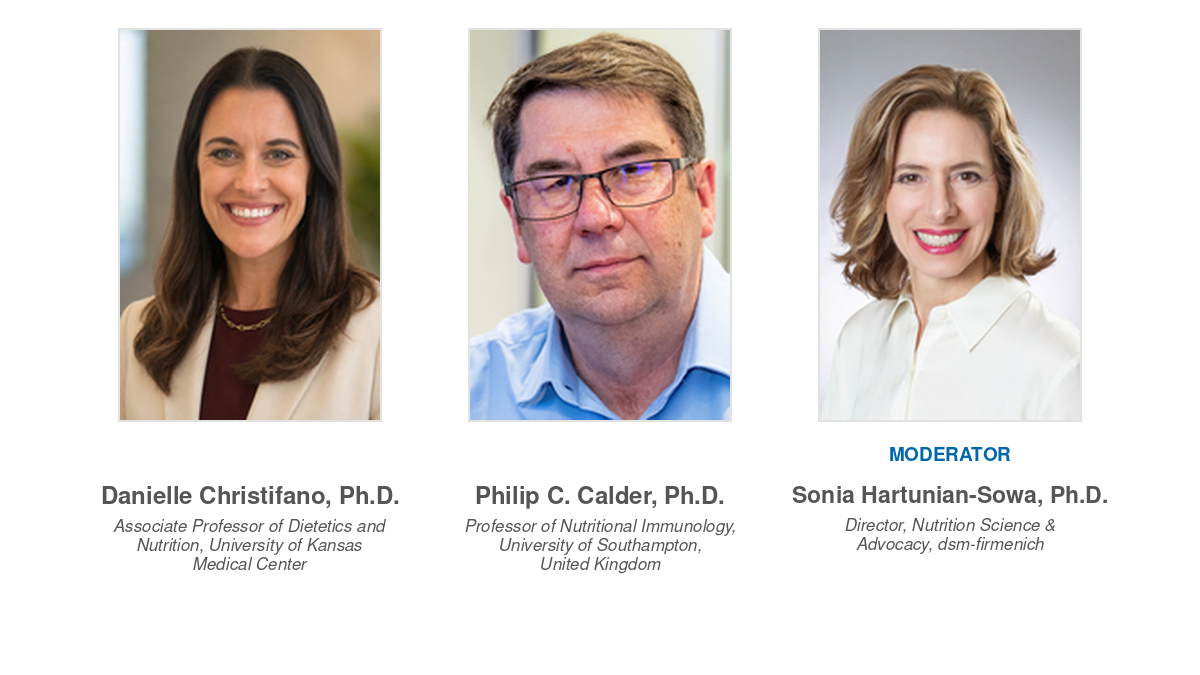
Omega-3 DHA and EPA session presenters Danielle Christifano and Philip Calder, with moderator Sonia Hartunian-Sowa

  • Danielle Christifano, Ph.D.
    Associate Professor of Dietetics and Nutrition, University of Kansas Medical Center
  • Philip C. Calder, Ph.D.
    Professor of Nutritional Immunology, University of Southampton, United Kingdom

Moderated by:

  • Sonia Hartunian-Sowa, Ph.D.
    Director, Nutrition Science & Advocacy, dsm-firmenich

REGISTER HERE.

Complimentary. Virtual. 90 minutes.

Open to government regulators, researchers, clinicians, policy professionals, and nutrition industry stakeholders worldwide.

Presenters

Danielle Christifano, Ph.D.

Danielle Christifano, Ph.D.

Associate Professor of Dietetics and Nutrition, University of Kansas Medical Center

Danielle Christifano, Ph.D., is an Associate Professor in the Department of Dietetics and Nutrition at the University of Kansas Medical Center. Her research focuses on maternal and infant nutrition, with an emphasis on omega-3 fatty acids, choline, and other nutrients that support healthy pregnancy outcomes and early-life neurodevelopment. She leads clinical and community-based research aimed at translating nutrition science into practical strategies to improve maternal and child health.

Dr. Christifano is a Past President of the U.S. Developmental Origins of Health and Disease (DOHaD) Society and serves on the Board of Directors of the International Society for the Study of Fatty Acids and Lipids (ISSFAL). She is also actively engaged in graduate education and mentorship at the University of Kansas Medical Center in master’s- and doctoral-level programs.

Philip C. Calder, Ph.D.

Philip C. Calder, Ph.D.

Professor of Nutritional Immunology, Faculty of Medicine, University of Southampton, United Kingdom

Philip Calder is Professor of Nutritional Immunology in the Faculty of Medicine at the University of Southampton, United Kingdom. He is an internationally recognized researcher in nutritional immunology and in the metabolism and functionality of fatty acids, with particular emphasis on the roles of omega-3 fatty acids. His research has both life-course and translational perspectives.

Professor Calder has received numerous awards, including the Danone International Prize for Nutrition, the DSM Lifetime Achievement Prize in Human Nutrition, the European Lipid Science Award, the GOED Lifetime Achievement Award, and the Alexander Leaf Lifetime Achievement Award from the International Society for the Study of Fatty Acids and Lipids. His leadership roles have included President of the International Society for the Study of Fatty Acids and Lipids, President of the Nutrition Society, and President of the Federation of European Nutrition Societies.

He was Editor-in-Chief of the British Journal of Nutrition and is currently Editor-in-Chief of Lipids and an Associate Editor of Clinical Science, Journal of Nutrition, Frontiers in Immunology, and Annals of Nutrition and Metabolism. Professor Calder has more than 800 peer-reviewed publications and is recognized as a highly cited author.

Moderator

Sonia Hartunian-Sowa, Ph.D.

Sonia Hartunian-Sowa, Ph.D.

Director, Nutrition Science & Advocacy, dsm-firmenich

Sonia Hartunian-Sowa, Ph.D., is a nutrition science, translation, and advocacy leader at dsm-firmenich. Her work focuses on translating nutrition research into evidence-based solutions and clear scientific communication, including the role of omega-3 fatty acids in supporting health across the lifespan. She brings experience spanning food science, nutrition, product development, education, and industry advocacy.
Council for Responsible Nutrition and CRN-I (“CRN”) Virtual Meeting Code of Conduct

CRN is committed to providing a safe, productive, and welcoming environment for all meeting participants and CRN staff. All participants, including, but not limited to, attendees, speakers, volunteers, exhibitors, CRN staff members, service providers, and all others are expected to abide by this Virtual Meeting Code of Conduct. 

CRN has zero-tolerance for any form of discrimination or harassment, including but not limited to sexual harassment by participants or our staff at our meetings. If you experience harassment or hear of any incidents of unacceptable behavior, CRN asks that you inform Sandra Khouri, Senior Vice President, Finance and Administration, skhouri@crnusa.org, 202-204-7673, so that we can take the appropriate action.

Unacceptable Behavior is defined as:

    • Harassment, intimidation, or discrimination in any form.
    • Verbal abuse of any attendee, speaker, volunteer, exhibitor, CRN staff member, service provider, or other meeting guest.
    • Examples of  verbal abuse include, but are not limited to, verbal comments related to gender, sexual orientation, disability, physical appearance, body size, race, religion, national origin, inappropriate use of nudity and/or sexual images in public spaces or in presentations, or threatening or stalking any attendee, speaker, volunteer, exhibitor, CRN staff member, service provider, or other meeting guest.
    • Disruption of presentations during sessions or at other events organized by CRN throughout the virtual meeting. All participants must comply with the instructions of the moderator and any CRN virtual event staff.
    • Presentations, postings, and messages should not contain promotional materials, special offers, job offers, product announcements, or solicitation for services. CRN reserves the right to remove such messages and potentially ban sources of those solicitations.
    • Participants should not copy, take screen shots, or video of presentations, Q&A, any chat room activity, or other activity that takes place in the virtual space. Video recordings of the presentations and presentation slides will be made available to you as noted in each meeting description.

CRN reserves the right to take any action deemed necessary and appropriate, including immediate removal from the meeting without warning or refund, in response to any incident of unacceptable behavior, and CRN reserves the right to prohibit attendance at any future meeting, virtually or in person.

Last Updated and Effective and Date: August 10, 2020 

Registration Now Open for the 2019 CRN-International Scientific Symposium in Düsseldorf, Germany, Nov. 28

—Roundtable on ‘health promotion’ to take place during Codex/CCNFSDU meeting— 

WASHINGTON,  Sept. 19, 2019—The Council for Responsible Nutrition-International (CRN-I), the international arm of the U.S.-based Council for Responsible Nutrition (CRN), has announced that its annual scientific symposium will be held on Thursday, Nov.  28, at the InterContinental Hotel Düsseldorf in Düsseldorf, Germany. The symposium, themed, “Roundtable on measuring health promotion: Translating science into policy,” takes place in conjunction with the 41st session of the Codex Committee on Nutrition and Foods for Special Dietary Uses (CCNFSDU), held at the same location Nov. 24–29. On Saturday evening, Nov. 23, prior to the start of the CCNFSDU meetings, CRN-I will hold a networking reception previewing symposium topics.

Registration for the CRN-I 2019 symposium and reception is complimentary for all Codex official country delegations and is available for a small fee to industry executives (CRN-I members receive one–three registration at no charge) via CRN-I’s website: www.crn-i.org.

The CRN-I symposium features presentations from prominent international experts from government, industry and academia. This year’s presentations will be followed by a moderated roundtable discussion with the goal of moving towards alignment on the definition of “health promotion.” The group will offer examples of outcome measures that are representative of the term and address potential scientific and policy implications. A representative from the World Health Organization (WHO) Department of Health Promotion will provide the keynote address.

Now in its 10th year, CRN-I’s symposium is highly regarded in the global scientific and regulatory communities. Reports from past CRN-I symposia are published in the European Journal of Nutrition (2011–2018) and in Regulatory Toxicology and Pharmacology (2010), with  translations in Arabic, Chinese, English, French, German, Japanese, Korean, Portuguese, Russian, and Spanish, available on the CRN-I website.